Does Skipping Reduce Weight? A Practical Beginner Guide
Discover the truth behind skipping for weight loss. Learn how this fun and effective exercise can help you shed pounds and achieve your fitness goals.
On this page
- Does skipping reduce weight on its own?
- How many calories does skipping burn?
- Does skipping reduce belly fat?
- How should a beginner start skipping?
- How much weekly exercise should you aim for?
- How can you make skipping safer?
- How do you track progress without overdoing skipping?
- Frequently asked questions about skipping for weight loss
- The bottom line
- Sources
Skipping can support weight loss by increasing activity, but 10 minutes of skipping does not guarantee a fixed calorie burn or a particular loss in kg. Body weight depends on the longer-term balance between food intake and energy use. A beginner should build a tolerable routine instead of chasing a promised number of jumps.
Does skipping reduce weight on its own?
Skipping uses energy and can contribute to an active lifestyle. Weight loss still depends on the overall eating and activity pattern. Adding rope sessions while also increasing food intake may leave body weight unchanged.
Fitness improvements can occur even when the scale changes little. Better coordination, confidence with the rope and completing an easy session more comfortably are useful observations. Avoid judging every week only by whether body weight falls.
Skipping is one exercise choice, not a required method of losing weight. Walking, cycling or another enjoyable activity may be easier to sustain. The most useful option is a routine that fits health, space, time and personal preference.
How many calories does skipping burn?
Skipping energy use varies with body mass, pace, technique and how much time is actually spent jumping. A 10-minute session with frequent pauses is different from 10 continuous minutes. A watch estimate should not be presented as a precise measurement.
The original article used the 3,500 kcal-per-pound rule as a predictable weight-loss calculation. That static rule misses changes in energy expenditure as body weight and behaviour change. The NIH explanation linked in Sources describes why simple arithmetic can overestimate results.
Avoid subtracting a watch’s calorie estimate from a meal as though both numbers were exact. Record activity duration and consistency instead. Use body-weight trends over time, alongside health and performance, to assess the broader plan.
Does skipping reduce belly fat?
Skipping does not let a person choose the body area from which fat is lost. Feeling the abdominal muscles work is not evidence of local fat loss. Waist changes depend on overall body-composition changes and individual factors.
Do not promise a flat stomach from 1,000 jumps a day or a fixed 30-day challenge. Rope skill and fitness differ, and jump counts do not describe total effort accurately. A sustainable eating plan and regular activity are more relevant than a target body-part claim.
Use ordinary meals to support the plan: dal, curd, paneer, chana, vegetables and suitable portions of rice or roti. Those foods do not need to be removed simply because skipping is part of the routine. Avoid extreme restriction or skipping meals to compensate for a missed workout.
How should a beginner start skipping?
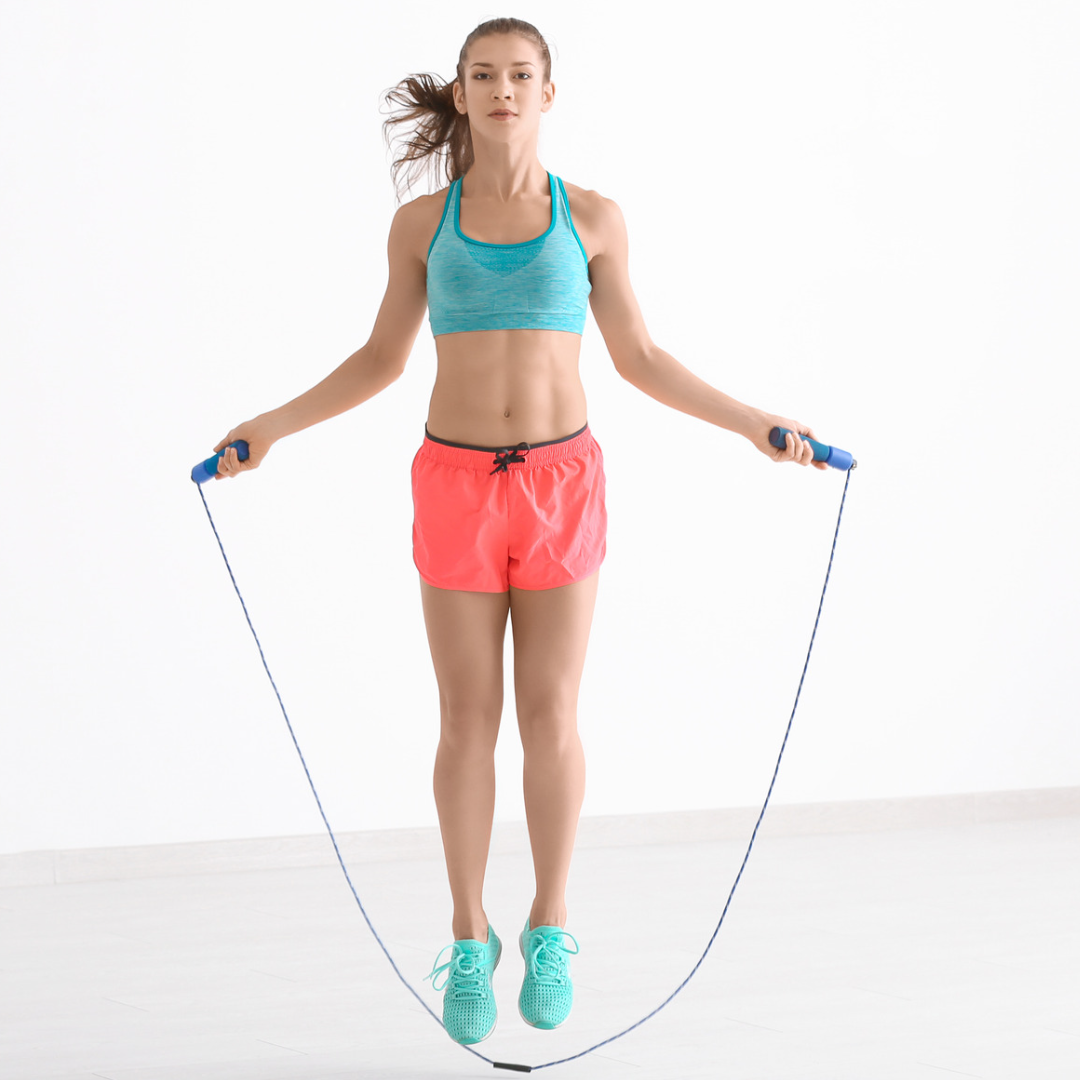
Begin with a few minutes of easy walking and comfortable movement. Then practise small, controlled jumps and an easy rope rhythm. Keep the rope session short enough that technique remains manageable.
One illustrative session is 6 rounds of 20 seconds of easy skipping followed by 40 seconds of rest or walking. That totals 2 minutes of jumping within a 6-minute interval session. The example is a skill-practice starting point, not a validated weight-loss prescription.
Use fewer rounds or practise without a rope if that is more comfortable. Allow recovery between early sessions and judge the next day’s response. Do not increase pace, jumping time and frequency all at once.
Progress by changing one small element after several comfortable sessions. An example is adding one round while keeping the same pace and rest. Persistent calf, shin, knee or foot pain is a reason to reassess rather than a signal to push harder.
How much weekly exercise should you aim for?
WHO guidance for adults describes 150–300 minutes of moderate activity or 75–150 minutes of vigorous activity each week, plus muscle-strengthening work on at least 2 days. These are general health guidelines, not a requirement to skip for every minute.
Skipping may be vigorous for many people, particularly beginners. Count actual activity rather than assuming that a session’s entire duration has the same intensity. Short rope practice can sit alongside walking and resistance training.
The original advice to skip for 30 minutes on 5 days each week is not an appropriate universal starting point. A new jumper may struggle with much smaller amounts. Build gradually and use lower-impact activities to create a routine that is easier to maintain.
How can you make skipping safer?
Choose a clear, non-slip area with enough room around the rope and above the head. Check the surface before starting. Avoid wet tiles, uneven ground and spaces where the rope could hit another person.
Use comfortable footwear and small controlled jumps. Keep the rope pace manageable and land softly without forcing a technique that causes pain. Technique advice reduces guesswork but cannot guarantee injury prevention.
People with existing injuries, painful joints, balance difficulties or cardiovascular conditions should obtain individual guidance before starting demanding rope exercise. Pregnancy and postpartum return to jumping also need advice suited to the person’s circumstances.
Stop for chest pain, faintness or unusual breathlessness and seek appropriate medical care. Someone with diabetes using medicines that can cause low blood glucose needs a plan for exercise and food. A rope workout should not override that plan.
How do you track progress without overdoing skipping?
Keep a simple record of rounds, actual jumping time and how the session felt. Note pain during or after the session. A comfortable repeatable session is a stronger basis for progression than a jump-count competition.
If weighing, use similar conditions and look at the pattern over several weeks. A single reading can reflect fluid, food and other short-term changes. Avoid interpreting the weight immediately after a sweaty session as fat loss.
Include resistance training when strength and muscle are goals. Skipping is not a replacement for a balanced strength programme. Combining activities can also reduce the pressure to make every rope session long and intense.

Also, Read 👉 6 Result-Oriented Pocket-Friendly Whey Proteins
Original shopping link: jump rope. Choose a rope suitable for the space and skill level; buying a rope does not establish a weight-loss outcome.
Frequently asked questions about skipping for weight loss
Can skipping alone make me lose weight?
Skipping may contribute to higher activity. Weight loss still depends on the overall food and activity pattern over time.
Is 1,000 skips a day necessary?
A fixed jump count is not necessary. Use manageable time intervals and good technique rather than copying someone else’s total.
Can I skip every day as a beginner?
Daily skipping is not a requirement. Allow recovery and increase frequency only when sessions and the following day remain comfortable.
Will skipping remove only belly fat?
Skipping cannot target a chosen fat deposit. Abdominal muscle work does not prove that belly fat is being removed.
Is walking a useful alternative?
Walking can be a useful lower-impact option. A consistent activity that suits the person is more useful than an uncomfortable rope routine.
Should I keep skipping through shin pain?
Persistent or worsening shin pain needs reassessment. Stop aggravating activity and seek professional advice when pain persists or interferes with normal movement.
The bottom line
Skipping for weight loss can be useful when the routine is comfortable and sustainable. Start with short practice intervals and progress gradually. Avoid fixed calorie, belly-fat and kg-loss promises. Combine activity with sensible meals, recovery and appropriate strength training.
Sources
Why is the 3500 kcal per pound weight loss rule wrong?
NIH Body Weight Planner — NIDDK


