Gain Healthy Weight: A Practical 30-Day Indian Plan
We will cover everything from diet to exercise and lifestyle changes that can help you achieve your goal of putting on weight.

On this page
- Who should check weight loss before increasing food intake?
- How can you judge whether extra calories are helping?
- What should you record during days 1–7?
- What can you add during days 8–14?
- How do you adjust the plan during days 15–21?
- What should you review during days 22–30?
- How can exercise support healthy weight gain?
- What allergy and medical cautions matter?
- Frequently asked questions about Gain Healthy Weight
- The bottom line
- Sources
For adults who need to gain healthy weight, adding around 300–500 kcal/day is a possible starting approach, not a promise of a fixed gain in 30 days. The NHS suggests this range for gradual weight gain. The first month is more useful for establishing regular intake and checking tolerance than demanding a particular number on the scale.
Who should check weight loss before increasing food intake?
Healthy weight gain begins by understanding why body weight is low. Sudden or unexplained weight loss, persistent digestive symptoms or difficulty eating should be assessed rather than blamed on a fast metabolism. A clinician can review the context before a generic 30-day food plan is used.
A weight-gain plan is different for a healthy adult with low intake and someone recovering from illness or prolonged food restriction. Severe undernutrition can require supervised nutritional rehabilitation. Children, pregnant people and adults with eating-disorder symptoms should not follow an adult gym-oriented plan without appropriate guidance.
How can you judge whether extra calories are helping?
An additional 300–500 kcal/day is a food-intake change, not an exact calorie surplus that can be confirmed without measuring expenditure. Activity and appetite can change when eating habits change. Start with a manageable addition and use the body-weight trend and symptoms to decide whether further adjustment is appropriate.
Calorie-to-kilogram formulas cannot predict a person’s 30-day result reliably. A review of muscle growth and energy surplus also found uncertainty about the exact surplus needed for hypertrophy. That review concerns resistance training rather than clinical underweight, but reinforces why body-weight gain should not be labelled automatically as muscle.
| Daily added intake | Added intake over 7 days | What the calculation means |
|---|---|---|
| 300 kcal/day | 2,100 kcal | Arithmetic total, not a promised kg gain |
| 500 kcal/day | 3,500 kcal | Arithmetic total, not a promised kg gain |
What should you record during days 1–7?
During days 1–7, record the meals and snacks you normally eat before making large changes. Note skipped meals, portion sizes, work hours and digestive discomfort. A food diary can reveal whether a busy schedule or poor appetite is reducing intake more than you realised.
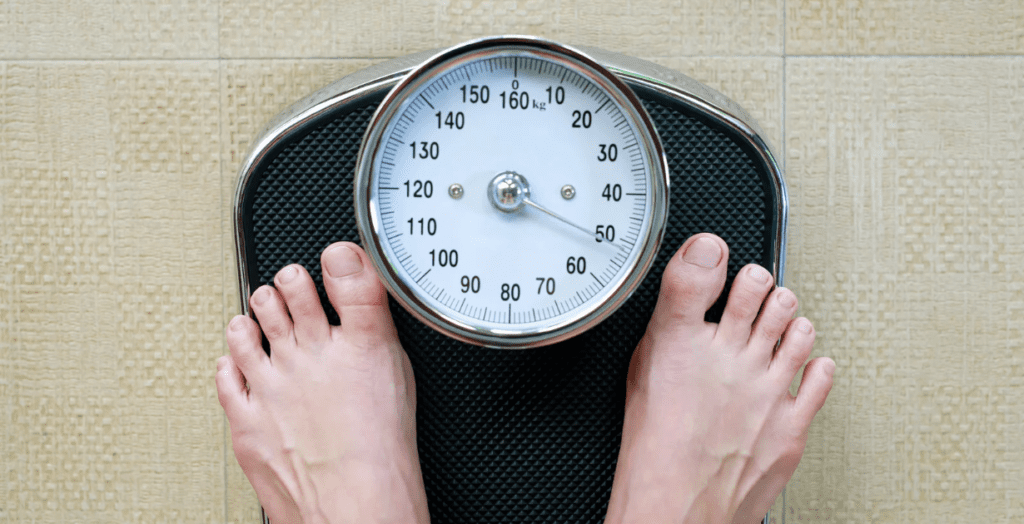
A weight record should use the same scale and similar conditions, such as mornings after using the toilet. Several readings across 7 days can show a trend more clearly than one measurement. Daily fluctuations can reflect water, food and bowel contents rather than a matching change in body tissue.
What can you add during days 8–14?
During days 8–14, choose one addition you can maintain, such as a planned snack or a larger portion at an existing meal. A practical schedule could use 3 main meals and 1–2 snacks, but that schedule is optional. Six meals are not required to keep metabolism active.
Indian meal choices can include dal, chana, rice, roti, paneer, curd, tofu, eggs or other foods that fit your preferences. Combine an energy source with a suitable protein food instead of simply enlarging a plate of rice. Actual serving size and recipe preparation determine the meal’s nutrient content.
A snack example could be 150 g of tolerated curd with fruit, or a measured 20–30 g portion of nuts alongside another food. These are portion illustrations, not calculated 300–500 kcal snacks. Check the label or recipe before assigning an energy value.
How do you adjust the plan during days 15–21?
During days 15–21, review whether the added food is being eaten consistently and whether digestion is comfortable. A diet plan cannot help if an inconvenient snack is repeatedly missed. Move the snack to a realistic time or choose an easier food before adding more complexity.
What should you review during days 22–30?
During days 22–30, compare the weight trend, appetite, digestion and consistency with the first week’s record. A dietitian can help change portions when the plan is not producing the intended direction of progress. A faster rise on the scale should not be treated as proof that the plan is healthier.
How can exercise support healthy weight gain?
Strength training can be included when health and fitness allow, with suitable technique and gradual progression. WHO recommends muscle-strengthening activity involving the major muscle groups on at least 2 days per week for adults. A coach can adapt the starting workload rather than imposing three demanding lifting sessions on everyone.
Cardio does not need to disappear from a weight-gain routine. Adjust food intake and training workload together rather than enforcing a universal 20–30-minute limit. Adults recovering from illness or experiencing fatigue need individual activity advice.
What allergy and medical cautions matter?
Milk allergy requires avoiding relevant dairy foods and whey; lactose intolerance is a different issue. Peanut, tree-nut, soy and other legume allergies need suitable alternatives to the snack examples. A 30 g peanut portion remains unsuitable for a person with peanut allergy regardless of the weight-gain goal.
Diabetes, kidney disease or medicines affecting appetite can change the appropriate food plan. People with diabetes should not assume a high-sugar shake is the right way to add energy. A qualified professional can tailor the calorie addition, food choices and monitoring.
Satisfy Your Cravings with South Indian Food Recipes
Frequently asked questions about Gain Healthy Weight
How much weight can you gain healthily in 30 days?
No exact 30-day gain is appropriate for every adult. Starting weight, health, activity and the reason for low weight affect the plan. Review the trend with individual guidance rather than chasing a fixed kilogram promise.
Is 300–500 extra kcal/day enough?
Adding 300–500 kcal/day is a possible starting approach for some adults, as suggested by the NHS. The range does not guarantee a particular result. Ongoing weight loss or medical concerns require assessment.
Do you need six meals a day?
Six meals a day are not compulsory for healthy weight gain. A pattern such as 3 meals and 1–2 snacks may be easier to maintain. Choose the schedule that supports adequate intake and comfortable digestion.
Can you gain healthy weight without mass gainers?
Mass gainers are optional rather than necessary. Regular foods and suitable portion changes can supply additional energy. Check allergens and the actual serving size if a supplement is used.
Should you stop cardio when trying to gain weight?
Cardio does not automatically need to stop. Food intake and exercise workload should be considered together. A person recovering from illness needs a suitable activity plan rather than a generic time limit.
Can a weekly target predict your monthly weight gain?
A rate of 0.5–1 kg/week would total roughly 2–4 kg over 4 weeks, not 2–4 pounds. That calculation corrects the units but does not establish a safe target for every adult. Monthly results should not be promised from simple arithmetic.
The bottom line
To gain healthy weight, first check the reason for low weight and build a manageable eating routine. An added 300–500 kcal/day can be a starting approach for some adults, with adjustment according to progress and health. Use the first 30 days to review consistency, tolerance and the weight trend. Seek individual advice for unexplained weight loss, medical conditions or restrictive eating.
Sources
Healthy ways to gain weight — NHS guidance for adults.
Is an Energy Surplus Required to Maximize Skeletal Muscle Hypertrophy Associated With Resistance Training — Slater and colleagues, 2019; applies to muscle growth, not clinical underweight treatment.
Physical activity — WHO adult activity recommendations.


